
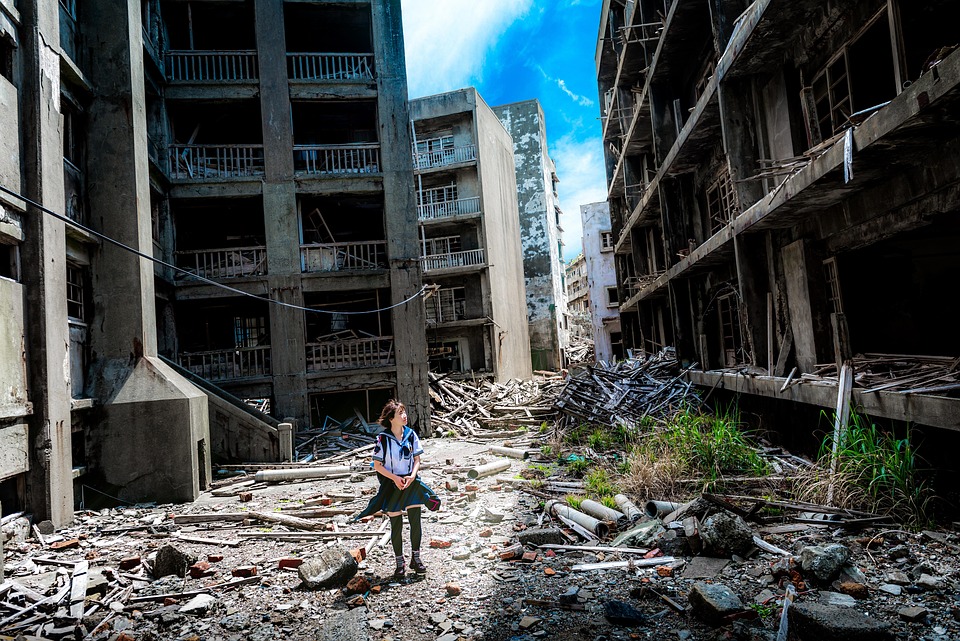
You probably heard a lot before about therm ghost town, a place once full of people, and now abandoned…. full of ghosts! Some places are said to be haunted, because of the reason why they are abandoned… Some people dare to visit them and report ,,strange” things there, even some human silhouettes and voices in dark!
But what are ghost towns at all and how one place can become like this?
By definition, a ghost town (deserted city or abandoned city) is an abandoned city, town, or village, usually with visible remains of past human occupancy (leftover of infrastructure, buildings, or roads). This therm also works for some parts of towns/cities/neighborhoods that are still populated, but much less than before (because people rapidly leave such places mostly due to unemployment).
A place can often become a ghost town for several reasons, either of economic activity that supported it has failed (industrial or agriculture mostly), due to human or natural disasters such as pollutions, wars, droughts, floods, volcanos, landslides/earthquakes, extreme cold or heat, economic activity shifting elsewhere, depleted natural resources, etc…

Ghost towns exist almost everywhere, on all continents. Some that preserve period-specific architecture, have become tourist attractions. Many became famous, and attract tourists and visitors from around the world. And due to events that created them as ghost towns, there are a lot of scary stories involving them. They are a good base for stories. Here are some of the famous/popular ghost towns:
Pripyat, Ukraine

Pripyat in Ukraine (SSSR back then) was abandoned after the Chernobyl disaster. It was a nuclear accident that occurred in Chernobyl Nuclear Power Plant on Saturday 26 April 1986. It is considered the worst nuclear accident in the history of both cost and casualties. About 49,000 people were evacuated from the area, mostly from Pripyat. Later, the exclusion zone was increased to 30 kilometers when a further 68,000 people were evacuated from the wider area. Many people later suffered health issues as a result of their exposure to radiation. The reactor explosion itself killed two operating staff members directly. 134 station staff and firemen were hospitalized with acute radiation syndrome due to absorbing high amounts of radiation. Of these 134 people, 28 died from the days to months later, and 14 suspected radiation-caused cancer deaths followed within the next 10 years.
Hashima Island, Japan

Hashima Island is one of the 505 uninhabited islands in Nagasaki Prefecture. Hashima Island is an abandoned island mine and tourist destination. Visitors can see overgrown industrial facilities, ruined concrete buildings for workers, and the so-called “stairway to hell”. Its undersea coal mines, established in 1887, operated during the industrialization of Japan. In 1959, the island had a population of 5259. In 1974, when the coal reserves were near depletion, the mine was closed and all of the residents moved from the island soon after, leaving the island abandoned.
Oradour-sur-Glane, France

Oradour-sur-Glane is a ghost town, an old village where Nazis committed the massacre. On 10 June 1944, Nazis killed 643 people there, including women and children civilians. This was supposed to be revenge for their captured officer (supposedly captured by French resistance). Just 6 people survived the attack. A new village was built nearby after the war, and this one is left untouched as a museum, memorial, and reminder.
Plymouth, Montserrat

The town of Plymouth on the Caribbean island of Montserrat is a ghost town that was the capital of Montserrat, a British overseas territory. It was made uninhabitable by volcanic ash from an eruption of the Soufrière Hills Volcano. The town was evacuated in 1995 when the volcano was erupting. Plymouth was abandoned permanently in 1997 after it was very damaged and mostly buried by lava and ashes. For centuries, it had been the only port of entry to the island. Currently, government buildings are on is Brades, while another, new capital is being created as a replacement, named Little Bay.
Fordlandia, Brazil

It was abandoned temporarily and rebuilt, while old abandoned parts and ruins still remain. When it failed, about 90 people lived there, now over 3000. It was established by Henry Ford, an American industrialist. It was created in the Amazon Rainforest in 1928 as a prefabricated industrial town intended to be inhabited by 10 000 people to secure a source of cultivated rubber for automobile manufacturing. But it was not successful despite Ford put a lot of millions into the project (he never visited the place either). The town had a strict set of rules imposed by the managers, and tobacco, alcohol, women, and even football were forbidden within the town, including inside the workers’ own homes. They also were forced to live in American-style housing and were given unfamiliar food, such as hamburgers and canned food. In 1930, the native workers grew tired of it and revolted in the town’s cafeteria. The rebels cut the telegraph wires, destroyed some infrastructure, and chased away the managers into the jungle for a few days until the Brazilian Army was sent and the revolt ended. The company relocated businesses in 1934.
Bannack, Montana, USA

Bannack was founded in 1862 and named after the local Bannock Indians. It was the site of a major gold discovery in 1862. It was briefly capital in 1864, until the capital was moved to Virginia City. Bannack continued as a mining town, and at one point, it had a population of about 10 000. There were bakeries, hotels, shops, markets, a grocery store, a restaurant, a brewery, a billiard hall, saloons… It was also noted that there, during the gold rush one gang operated, and stolen gold while it was being transported. They killed many travelers who resisted. Sheriff of Bannack itself, Henry Plummer, was accused of leading the group and was executed in January 1864, along with several other gang members. As many towns depending on gold mines, Bannack started to decline as well. The last residents left in the 1970s. Now, it is a tourist attraction.
Dhanushkodi, India
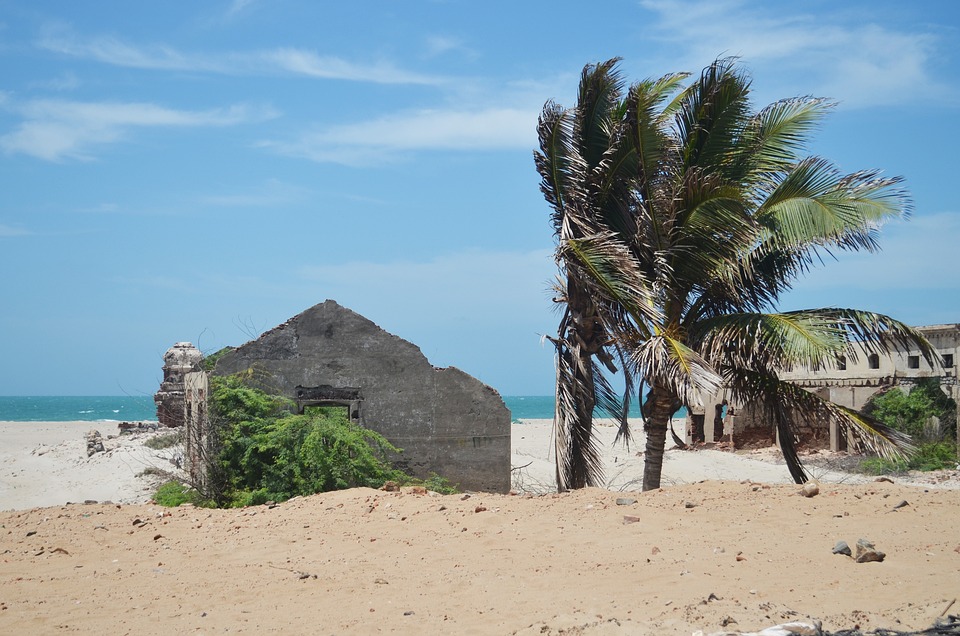
Dhanushkodi is a ghost town in the southeastern part of Pamban Island in India. It is close (25kms west) from Sri Lanka. This region is prone to heavy geomorphic activity. Also, in December 1964, depression was formed, which later created a heavy cyclone. It made landfall at Dhanushkodi on the night of 22–23 December. The estimated wind was 280 kilometers per hour and waves were 7 meters high. Around 1800 people died in the cyclonic storm including 115 passengers on board the passenger train. The entire town was destroyed and the government declared Dhanushkodi unfit for living.
Deception Island, Antarctica
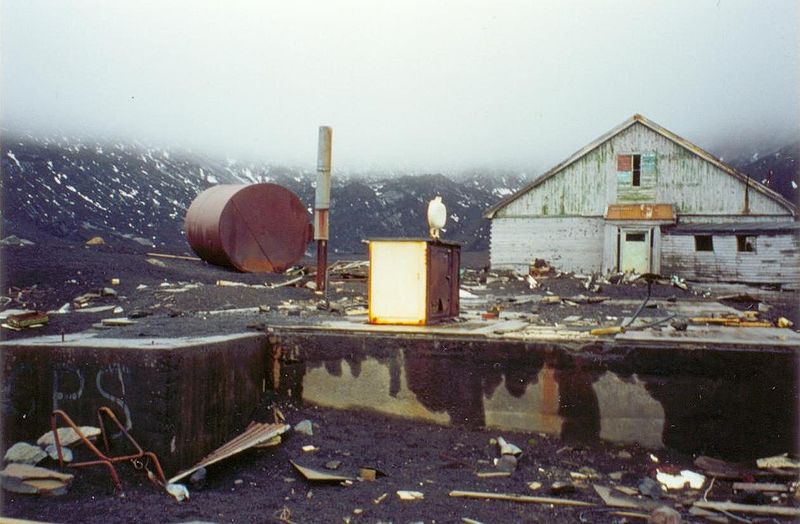
Deception Island is located in the South Shetland Islands close to the Antarctic Peninsula with a large and safe natural harbor. There, in 1906, a Norwegian-Chilean company set up a whaling station at Whalers Bay. They used it as a base for their factory ship, and by 1914 there were 13 factory ships located there. That station stopped being profitable during the Great Depression and was abandoned in 1931. Later, in 1969, the station was partially destroyed by a volcanic eruption. There are also many abandoned scientific and military bases in Antarctica, especially in the Antarctic Peninsula.
Varosha, Northern Cyprus

In the early 70s, Cyprus was famous spots for rich people to visit in the Mediterranean. Varishka itself was a modern town at that time, attracting many people. But prior to the Turkish invasion of Cyprus in 1974, its citizens fled from the city. It is uninhabited even today. Buildings have decayed, some buildings have been looted over the years, some streets have been overgrown with vegetation. Entry is partly open to the public.
Craco, Italy

A ghost town, Craco, is a medieval village in the Italian region of Basilicata, which was evacuated after a landslide in 1963. The town sits atop a 400 meters high cliff that overlooks the Cavone River valley. Throughout the area are many vegetation-less parts formed by intensive erosion. Erosion and landslide itself caused this town to be abandoned. Now, it is a popular tourist attraction and a popular spot for filming movies.